“WRITING NEW RULES. What makes S/M work at all is that, in order to play, we intentionally alter the customary rules of personal responsibility, and enter into a ritualized codependency. The ritual is what makes it possible, and safe, to travel in the uncharted psychological territory of bottom space.
“Janet says: When I teach my classes for novice tops, I say: “Normally, you have a ‘bubble’ of protectiveness you put around yourself to prevent yourself from being physically or emotionally hurt. When you agree to top someone, you’ve just agreed to put that bubble around you and your partner for the duration of the scene.” – The New Topping Book by Dossie Easton & Janet W. Hardy
While reading through The New Topping Book I came across the above passage, which reminded me a lot of Fuchs and Koch’s interaffectivity.
In this passage, the authors describe how a power exchange in a kink scene results in the bottom giving up their autonomy – including physical and emotional safety – to the top. While bottoms must be aware of their limits and must indicate (through a safeword) if something goes wrong, the deliberate imbalance of power requires that tops are responsible for ensuring the wellbeing of everyone involved in the scene. This shift doesn’t just mean that tops must enclose the bubble around the bottom, but also that the bottom must trust the top enough to be vulnerable.
Something the authors mention repeatedly throughout the book is that “the top takes more than the bottom offers, but less than the bottom is willing to give” or that “the top trades his or her energy for the bottom’s armor”. These quotes illustrate how this power exchange happens, and why it is necessary to create such a space. Bottoms are taken to a place of discomfort that they cannot reach themselves, but enjoy and consent to entering into. This is one aspect that differentiates scenes from everyday exchanges as the participants are not equal in their defenses1.
Thus, this power exchange is bidirectional: the top initiates that space through some sort of ritual (breathing together, music, sexual behaviour, commanding a certain pose), which the bottom volleys back by responding to them (responding to the command, getting into position, etc.). This energy is then shared throughout the scene.
Interaffectivity
In Fuchs and Koch’s model of interaffectivity, emotions (or affect) are shared and embodied. Emotions are something we feel in our bodies (bodily resonance) which then drives us to act and express that emotion. We are impacted by people and environments that afford certain emotions. Such an interaction might result in intra-bodily resonance, where person A’s expression impacts person B’s emotion, which impacts person A, resulting in a sort of recursive loop.
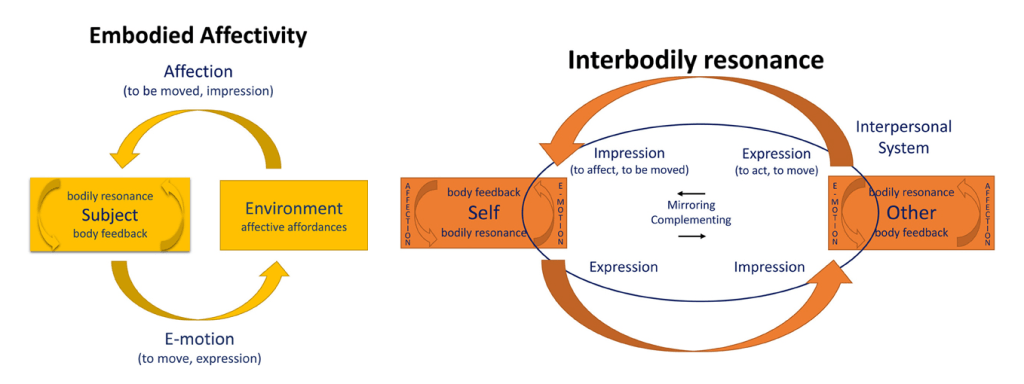
An example of this situation might be walking into a room and getting a sense of the ‘mood’ before you even sit down for the conversation. This also happens in conversations (inter-bodily resonance). During a particularly good conversation with someone, we might be reaching a certain low or rhythm of words, mimicking each others expressions or posture, which also results in a certain affect to that overall experience.
If we were to apply that to a kink scene, we would see that the power exchange happens in this inter-bodily resonance. The top and bottom are both expressing themselves and getting the impression of the other person. The bottom might respond to the top by expressing embarrassment from a command by hesitating and lowering their eye gaze, which affords the top with their next action.
Such a resonance can emerge naturally – just like an engaging conversation. However, as I addressed above, rituals such as music or breathing together can also elicit this resonance by synchronizing one’s feeling of their body with another.
While this was just a similarity I noticed between what Easton and Hardy describe, and what Fuchs proposes, I would be interested to see what other examples there might be of this interaffectivity during scenes: what people do pre-scene to prepare, and what observations they have made as tops (or bottoms).
 Ruby Prinsen
Leave a comment